
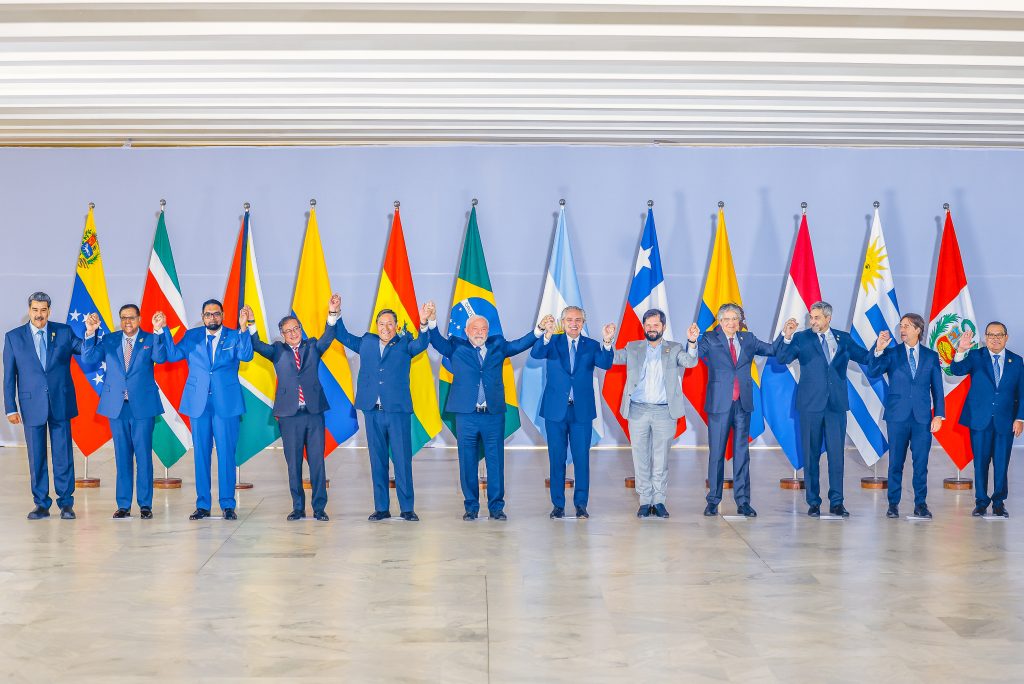
At a presentation of a friend, whose doctoral research was predicated on a Gramscian understanding of hegemony operating at the level of regional integration of the Union of South American Nations – UNASUR – a few years ago, I was taken aback by his seemingly excessive optimism towards the UNASUR experience. I manifested doubts and reservations at the possibilities of perenniality, in specific, whether the presumption regarding consensus in decision-making would survive in the event of right-of-centre regimes coming into office in UNASUR member states. This academic exchange occurred at a moment when social and political turmoil here in Brazil had yet to oust former president Dilma Rousseff of the Brazilian Workers’ Party (PT) from office, under highly questionable circumstances, over charges of corruption that garnered widespread support from business circles, mainstream corporate media outlets, and from a variety of civil society associations, but from which she was subsequently and crucially cleared. Similar turbulence had been experienced by Paraguay in the early 2010s.
At present, South America enjoys three institutions competing and often overlapping for the centrepiece of regional integration initiatives. The MERCOSUR (Southern Common Market), the now defunct UNASUR (Union of South American Nations), and the recently convened PROSUR (Forum for the Progress and Development of South America). Whilst the MERCOSUR is by far the most consistent and robust of the three ever since its inception with the Asunción Declaration of 1991, it has been challenged since the end of the last decade by the other two. The now defunct UNASUR came into effect in 2010, once eight nations of the region has ratified the foundational treaty (2008). Whilst member nations opted not to compete with existing trade bloc, they also aspired to form a political union, with the European Union as reference, yet again. Its membership peaked at twelve members, but has seen numbers dwindle as of late currently standing at five, Bolivia, Uruguay, Venezuela, Suriname, Guyana (Mexico and Panama are observers). The PROSUR, on the other hand, has emerged since January of 2019, with the deliberate intention of replacing the UNASUR. The initiative was spearheaded by right-of-centre presidents Piñera (Chile) and Duque (Colombia), to which six other nations were quick to join ranks (Brazil, Argentina, Ecuador, Guyana, Paraguay and Peru). In common, these nations are currently governed by right leaning coalitions.
As the current decade draws to an end, the South American party-political landscape has undergone substantial transformation. As the series of electoral contests in the main polities come to an end, it would be a challenge to argue that the results have not brought in a new cycle. If one is to follow the bandwagon, the preceding decade, one of left-of-centre electoral victories, triggered by electoral victories of Chavez in Venezuela (1998), it would emerge that the centre of the current scenario in regional politics has clearly shifted towards the right.
By the account of the proponents of Neoliberalism, it has enjoyed a rich and fruitful history within South America. From the earliest attempts at experimentation of such policies under the dictatorship of Augusto Pinochet in Chile, whose Chicago Boys undertook the roles of junior managers forcefully thrusting an agenda over a society ill-equipped to resist, under the auspices of one of the most notoriously brutal military regimes. It preceded the implementation elsewhere, the administrations of Thatcher and Reagan.
The following decade, the 1980s, was marred by the inaugural use of the international economic institutions such as the International Monetary Fund, and World Bank Group by the Reagan administration to further an agenda of monetary stabilisation in the face of wayward inflation, and austerity and privatisation programmes, as a means of achieving balanced budgets. Gone were the days of excess liquidity of lending institutions of the 1970s, and in came a new atmosphere of uncertainty, a fundamental distrust of the region’s ability to honour its international commitments. Suspicions were thereafter heightened as the economies of major economies of South and Central America defaulted on their substantial debts.
The 1990s brought about the seizure by neoliberal politics of a developmental agenda put forward by the economists of international institutions based in Washington D.C., spearheaded by the World Bank’s then chief economist, John Williamson. The Washington Consensus (W.C.) initiative became both synonymous and symbolic of a developmental agenda in the Post Cold War era far beyond the confines of South America. Much of the developing world, in Eastern Europe, South East Asia, and even Russia itself were pressured into the adoption of a neoliberal agenda.
Outright rejection of Neoliberal politics at the polls have consistently marked the region. As a rule, implementation of the W.C. followed outright denial during the presidential electoral campaigns of those heads of State most identified with the rampant neoliberalisation of the 1990s, Carlos Menem, Fernando Henrique Cardoso, Alberto Fujimori, Carlos Andrés Peres. Pledges in favour of the Consensus were perceived as a liability at the ballot. Indeed, this trend appears to have only been initially reversed with Macri’s election in Argentina in 2015.
In the rear end of the 1990s, the consequences of rampant neoliberalisation reared its ugly head. The crises undergone in major economies (South East Asia in 1997, Russia in 1998) were anticipated by those in Latin America Mexico (1994), and also followed by Brazil (1999) seemed to be indicative of the nefarious albeit unintended consequences – at least for some. Beyond the financial markets, many of the economies affected faced a meltdown.
Although unaffected directly by financial tribulation, the case in Venezuela manifested social crises stemmed from the economic disintegration brought about by the adoption of neoliberal policies. Increased polarisation in a region distinguished by extraordinarily high levels of wealth concentration generated turmoil. Economic catastrophes translated to the political sphere with dire consequences for representation. It is in the wake of the failures of neoliberal policies that Hugo Chavez emerged. Chavez was able to secure his own electoral victory in 1998 in the oil-dependent Venezuela, presenting himself as a political outsider to Venezuela’s bi-party political system embodied in the Pacto de Punto Fijo. Neither the social democrats of the Accion Democratica nor the business-friendly representatives of the COPEI were a match for Chavez’ brand of left-oriented populist discourse. His rise to power in 1999 was a landmark for what was to occur in the region during the following decade. Elsewhere, although tempered by diverse attempts, with equally distinct success stories, at distancing from neoliberalism in office.
South America had turned left, according to a narrative that became widespread, the “pink tide” as it became known. This reading was strengthened by a string of electoral victories by political forces and coalitions understood to be loosely affiliated with the Left that followed: Lula in Brazil (2002), Kirchner in Argentina (2003), Morales in Bolivia (2005), Bachelet in Chile (2005), Correa in Ecuador (2006). To suggest high levels of convergence in the policies undertaken by the administrations of this group of heads of government is highly problematic. However, the narrative had been consolidated.
In the meantime, the Common Market of the Southern Cone, the MERCOSUR, continued regional integration as by far the region’s most expressive forum, largely irrespective of the political orientation of the coalitions that were coming to power in member states. Born in the aftermath of the redemocratisation era of the late 1980s, the MERCOSUR had evolved through institutional strengthening and capacity building, in addition to significant expansion. It has benefited from gradual enlargement of members, a clear indication of the privileged position it represented at the centre-spot of regional integration.
As such, the UNASUR surfaces in the midst of a political landscape in which the left-leaning governments held office in the vast majority of South American nations. Further still, the figure of then Venezuelan president Hugo Chavez became paramount as the leading and most representative face of the initiative. Not by chance has it been associated with that conjuncture. Moreover, it has been the regime of Chavez’s successor, Nicolas Maduro that induced the renunciation of its members in the aftermath of political turmoil Venezuela has faced in recent years, coupled with the view shared by the governments of conservative orientations that political pressure ought to have been exerted upon its failing democratic institutions.
The emergence of the PROSUR reflects this fundamental shift in political ideology of governing coalitions towards the right-of-centre. Indeed, as a new regional integration initiative emerges in the wake of significant changes at the helm of South American states, with right-of-centre political coalitions coming to power, albeit through heterodox paths as non-electoral trajectories once again characterise the current decade. Nonetheless, in Argentina (Macri, 2015), Chile (Piñera, 2010 to 2014; 2018), Paraguay (Franco, 2012), Honduras (Sosa, 2010) Brasil (Temer, 2016) we have witnessed the replacement of left-wing governments.
Yet, PROSUR faces a similar dilemma to that which has struck the UNASUR so unyielding. Who is to say a future transformation of the political landscape regarding the orientation of governing coalitions would not place the PROSUR under a similar scrutiny to that which has all but submerged the UNASUR to political irrelevance?
The crux of the matter of understanding South American regional integration appears to present us with two tiers. On the one hand, it is imperative to understand the success of any project has to prove itself capable of overcoming the challenges faced by the influence of political ideologies over membership. The frailty of the region’s advancement towards deeper integration has become evident through the ease with which concurring initiatives burgeoned in the last two decades. Regional integration encompasses a broad set of political initiatives that find at its heart a commitment that cooperation is both a means and an end in itself. It requires the expansion and engagement of a set of structures that aim to ameliorate the conditions for development in the region. It unwaveringly does not require that the confluence of the ideological underpinnings of coalitions in power in member countries.
Further still, the second tier points towards the fact that UNASUR and PROSUR are products of specific conjunctures. It suggests a seeming vulnerability and superficial understanding of the benefits of integration. A deeper challenge may be that of encompassing the matter into the day-to-day political discourse of the region’s nations. From the perspective of the Brazilian political system, it is challenging enough that foreign policy is routinely relegated to an afterthought in the political debate. For instance no explicit mention was awarded to the realm in the campaign manifesto of the Bolsonaro’s victorious presidential bid in 2018.
The ease with which those in power hijack such initiatives of regional integration to satisfy the narrow ideological agendas of the ruling coalitions conversely seems to strengthen the MERCOSUR, which has emerged relatively unscathed from such challenges. That is not to say South American integration is not already wrought with substantial obstacles, bearing in mind the economic and political turmoil of the last decade. Ideology does not need to be an additional hindrance. It may well be the case that PROSUR initiative is doomed to inevitable failure. An organisation that predicates itself on transient domestic political arrangements pertaining to those in effective power at any moment in time in member states is structurally unsound. This seems to be the lesson bequeathed by UNASUR, albeit one that PROSUR may struggle to ignore.
Rather than seeking consensus in the Gramscian notion put forward by my colleague, what is thus required is for integration to be embodied by policies and politics of the states of South America. Political will, or the hegemonic consensus construed within historic blocs for Gramsci, an understanding that goes far beyond narrow ideological stances, is at the heart of any form of international cooperation. Regional integration, as a subset is not exempt from such a requirement.